
Strange & Hidden
Desert View Tower (Jacumba)
Bert Vaughn's 70-foot stone lookout has guarded the old Mountain Springs pass since the Route 80 era—and Boulder Park is carved into the rocks around it.
A castle at the lip of the escarpment
Every winter, thousands of drivers cruise Interstate 8 between Yuma and San Diego, climbing out of the below-sea-level Imperial Valley into the jagged granite boulder fields of the In-Ko-Pah Mountains.
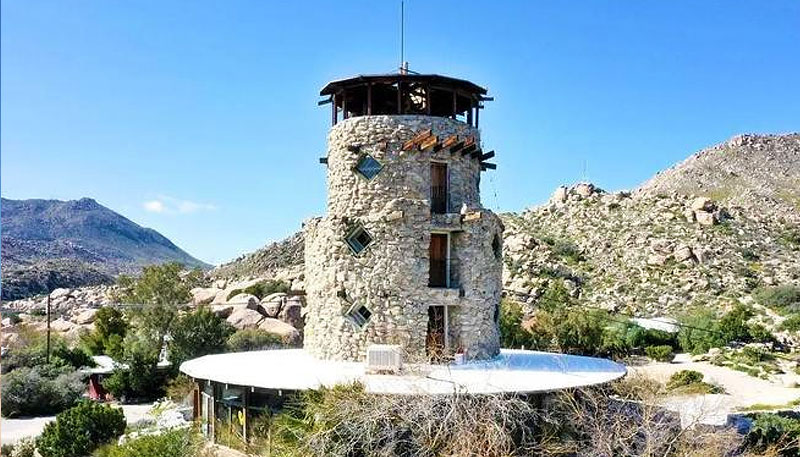
Perched at the lip of that dramatic 3,000-foot escarpment—just east of Jacumba Hot Springs—stands a 70-foot-tall stone castle that looks like it was plucked out of medieval Europe and dropped onto a California cliff.
Built in the 1920s along the treacherous old U.S. Route 80, the Desert View Tower spent the last century as a pioneer memorial, a radiator-cooling pit stop for overheating Model Ts, a World War II plane-spotting lookout, and a one-of-a-kind Great Depression folk-art playground.
The brutal pass before the highway
Long before Interstate 8 blasted smooth grades through the rocks, crossing the In-Ko-Pah Mountains between Yuma and San Diego was one of the most punishing journeys in the West.
Between 1862 and 1870, freighters traveling the old stage route had to unhitch their horses at nearby Mountain Springs Station and pay teams of oxen to haul heavy wagons up a grueling 30-percent mountain grade.
When early automobiles began making the trek in the 1910s and 1920s—after crossing the Imperial Sand Dunes on the famous Old Plank Road—climbing the steep pass routinely boiled radiators dry.
The tower was built for that roadside moment: a reason to stop, cool down, and look back at the country the road had just crossed.
Bert Vaughn's roadside castle
In 1920, San Diego real estate developer Robert "Bert" Vaughn bought up the entire town of Jacumba Hot Springs, hoping to turn the mountain pass into a booming resort and international border hub.
To lure motorists off the dusty highway and into his nearby café and bar, Vaughn began building a massive stone lookout tower in 1922.
Constructed rock by rock using local granite and salvaged timber from the Old Plank Road—with four-foot-thick stone walls at its base—the Desert View Tower was completed in 1928.
Early travelers paid a quarter to climb its narrow spiral staircase, sign the guest registry, refill their steaming car radiators, and gaze out across the Imperial Valley, with views stretching toward the Salton Sea and the Yuma desert on clear days.
During World War II, the tower's panoramic perch served a vital military purpose as an official civilian lookout post watching the skies for enemy aircraft.
Boulder Park: art carved into stone
In 1933, during the depths of the Great Depression, an unemployed engineer named Merle Ratcliff—also spelled Ratcliffe—arrived at the tower.
Over the next two years, reportedly working for a dollar a day, room and board, and a jug of wine, Ratcliff chiseled whimsical sculptures directly into the natural quartzite boulders surrounding the tower.
The resulting outdoor gallery, known as Boulder Park, features dozens of animals, reptiles, faces, and secret stone pathways carved right out of the hillside.
It is folk art at landscape scale: part sculpture garden, part maze, and part reminder that the Depression reached even this high, lonely pass.
A landmark worth the stop
Together, Desert View Tower and Boulder Park were designated California Historical Landmark #939 and added to the National Register of Historic Places in August 1980.
The tower is a roadside attraction, not a state park. Check current opening status and hours before making the drive, especially outside the winter season.
If the gate is open, give yourself time for both the tower and the boulders. The view explains the name; Boulder Park explains the cult following.
Questions
Before you go
Where is Desert View Tower?
It is in the In-Ko-Pah Mountains near Jacumba Hot Springs, California, just off Interstate 8 at the In-Ko-Pah Park Road exit, about an hour west of Yuma.
Can you climb the tower?
The tower has historically been open to visitors via its spiral staircase. Check current opening status and hours before driving out, since access can change seasonally.
What is Boulder Park?
It is the Depression-era collection of animals, faces, and pathways that Merle Ratcliff carved into the quartzite boulders beside the tower in the 1930s.
Last reviewed: November 17, 2026. See our sources and editorial policy.