
Historic Yuma
Ocean to Ocean Bridge
The first highway bridge across the lower Colorado was built on barges, floated into place, and has now carried traffic, migrants, and memories for more than a century.
A bridge the Colorado tried to stop
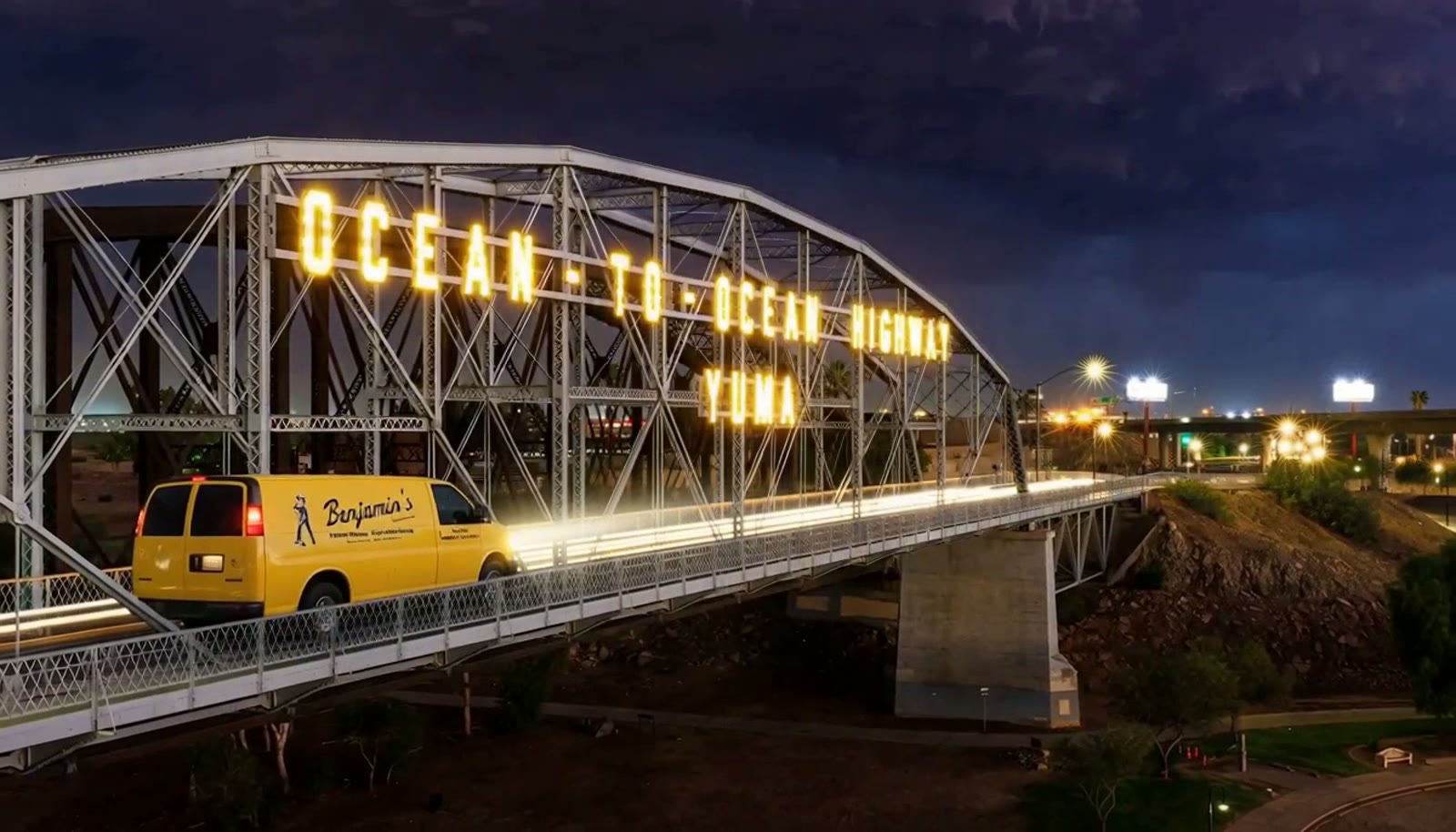
The Ocean-to-Ocean Bridge rises between the granite bluffs of Yuma Territorial Prison and the cottonwoods of Gateway Park. It looks like a relic from another century because it is—and its arched steel span still carries cars, cyclists, and pedestrians across the Colorado.
In the early 1910s, America was falling in love with the automobile, and "Good Roads" boosters dreamed of a continuous transcontinental route linking the Atlantic and Pacific. At Yuma, travelers still crossed by wooden ferry or had to ask permission to use the railroad bridge.
In 1913, Arizona Congressman Carl Hayden pushed a federal bill through Congress to fund a steel highway bridge at Yuma. Part of the justification was safe passage for members of the Fort Yuma Indian Reservation.
Construction began in October 1914, and the river immediately fought back. Twice that winter, seasonal floods tore through the canyon and washed away the contractors' wooden falsework.
Engineers tried a bold workaround: they assembled the massive curved steel spans on barges upstream and floated them downriver into position onto concrete piers. On May 22, 1915, Yuma celebrated with parades, concerts, horse races, and giant electric signs spelling out "Ocean to Ocean Highway Yuma." The bridge cost $73,800.
The only crossing for 1,200 miles
When it opened in May 1915, the bridge became the first highway crossing over the lower Colorado River. For 1,200 miles, it was the only automobile bridge across the river.
That isolation made it a lifeline. In 1926, it officially became part of U.S. Route 80, carrying Model Ts, cross-country tourists, and heavy freight between San Diego and the East Coast.
The bridge was a bottleneck and a landmark. Its steel truss—Arizona's only Pennsylvania truss bridge—became one of the most recognizable pieces of infrastructure in the desert West.
A Dust Bowl checkpoint
During the Great Depression, the bridge took on a darker role. As thousands of Dust Bowl migrants headed west toward California in search of farm work, California authorities stationed state police on the span.
Travelers who could not prove they had cash in their pockets or a guaranteed job waiting in California were turned back at the river.
Stranded on the Arizona side, hundreds of families settled permanently along the riverbank, giving birth to the Yuma neighborhood still known today as "Okietown."
Bypassed and closed
As postwar traffic boomed, the narrow bridge could not keep up. A wider highway bridge opened downstream on Fourth Avenue in 1956, followed by Interstate 8 in the 1970s.
By 1988, structural wear forced officials to close the Ocean-to-Ocean Bridge to motor vehicles altogether, leaving it fenced off for walkers and bicycles.
A $2 million second life
Rather than let history rust away, local preservationists, Yuma County, and the Quechan Nation rallied behind a $2 million to $3 million restoration.
In February 2002, the bridge was rededicated and reopened to one-lane vehicular traffic, complete with a replica of its glowing 1915 "Ocean to Ocean Highway" sign.
In 2018, it was officially designated as part of Historic U.S. 80. More than a century after it opened, the bridge still works for a living—carrying cars, bikes, and pedestrians between the prison bluff and Gateway Park.
Questions
Before you go
Can you still drive across the Ocean to Ocean Bridge?
Yes. It reopened to one-lane vehicular traffic in 2002 and also carries cyclists and pedestrians.
Why is it called the Ocean-to-Ocean Bridge?
The name comes from the early 20th-century Ocean-to-Ocean Highway, a transcontinental route promoted to link the Atlantic and Pacific coasts.
Where is the bridge?
It spans the Colorado River between Yuma Territorial Prison and Gateway Park in Yuma, Arizona.
Last reviewed: November 17, 2026. See our sources and editorial policy.