
History
The Riverfront That Came Back
Charles Flynn's 19-year mission to restore Yuma's waterfront
A riverfront lost and found
If you walked along the south bank of the Colorado River in Yuma during the 1990s, you would not have found cottonwood groves, sandy beaches, or smooth paved bike paths. Instead, you would have found a neglected, overgrown corridor choked by invasive salt cedar, fenced off by industrial yards, and—on the west end—literally buried beneath Yuma's former municipal garbage dump.
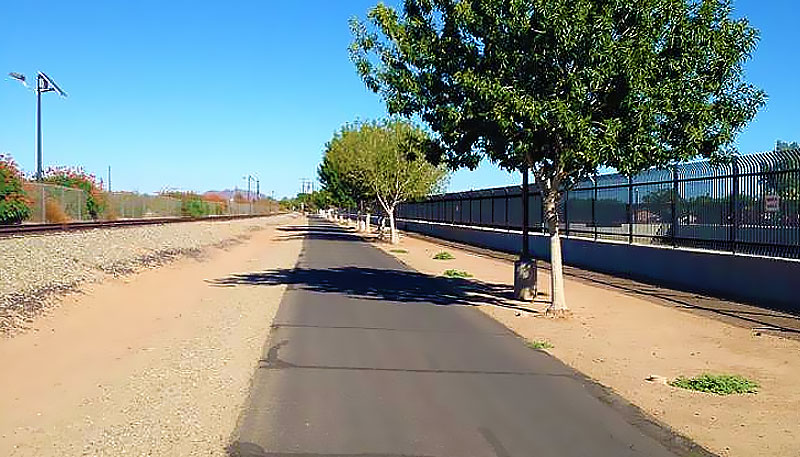
Today that same stretch of riverbank is the crown jewel of downtown Yuma. Linking the West Wetlands to the East Wetlands, the Charles Flynn Riverfront Trail honors the visionary leader who spent nearly two decades turning a forgotten riverfront back into Yuma's front porch.
"People wanted a re-connection to the riverfront. And that then also developed a tremendous bipartisan support." — Charles Flynn, founding executive director of the Yuma Crossing National Heritage Area, on his 2018 retirement
Who was Charles Flynn?
When Congress designated the Yuma Crossing National Heritage Area in 2000—making it the first National Heritage Area west of the Mississippi River—Charles Flynn stepped in as its executive director.
Over the next 19 years, Flynn led a multi-million-dollar, bipartisan effort uniting the City of Yuma, the Fort Yuma Quechan Indian Tribe, state park officials, farmers, and local volunteers. Together they cleared decades of invasive brush and industrial debris, re-established natural river channels, planted thousands of native cottonwoods and willows, and built a seven-mile network of contiguous riverfront parks and trails spanning 400 acres of restored wetlands.
When Flynn retired in 2018, community leaders unveiled a permanent monument at Gateway Park on November 9, officially naming the riverfront trail system after him.
Riding and walking the trail
Whether you ride a 1.3- to 2.6-mile segment or connect the full multi-mile corridor from West Wetlands through the East Wetlands, the Charles Flynn Riverfront Trail offers an effortless, completely flat route through Yuma's living history.
- West Wetlands Park (western anchor): Once a landfill, this 110-acre park now features shaded cottonwood groves, Centennial Beach, a hummingbird garden, protected burrowing owl habitats, and a fishing pond.
- Gateway Park and Prison Hill (central hub): Passing beneath the 1915 Ocean-to-Ocean Bridge and the granite bluffs of the Yuma Territorial Prison, this section features the official Charles Flynn Riverfront Trail dedication monument, sandy river access, and interpretive plaques detailing Yuma's riverboat and railroad eras.
- Yuma East Wetlands and Sunrise Point (eastern anchor): Continuing east past Sunrise Point Park, the path winds alongside more than 350 acres of restored marshes where great egrets, ospreys, herons, and pelicans thrive beside downtown.
The route is flat, paved, and easy to sample in pieces. It also connects directly to the Yuma Crossing Bike Path, the Ocean-to-Ocean Bridge, Pivot Point Plaza, and the historic downtown waterfront.
Keep reading
Follow the next thread.
 History
Secrets Beneath the Sand
The complete story of Yuma, from the river crossing to the winter salad bowl.
Read the story History
Pearl Hart: The Bandit Queen of Yuma
Pearl Hart robbed a stagecoach, fooled a jury, and escaped Yuma Prison.
Read the story History
The Dark Cell
America's most haunted room. Cold spots, scorched handprints, and a whisper that says Stay.
Read the story