
History
Pivot Point: The Midnight Crossing
How a railroad bridge and a concrete turntable changed Arizona
A locomotive on the old main line
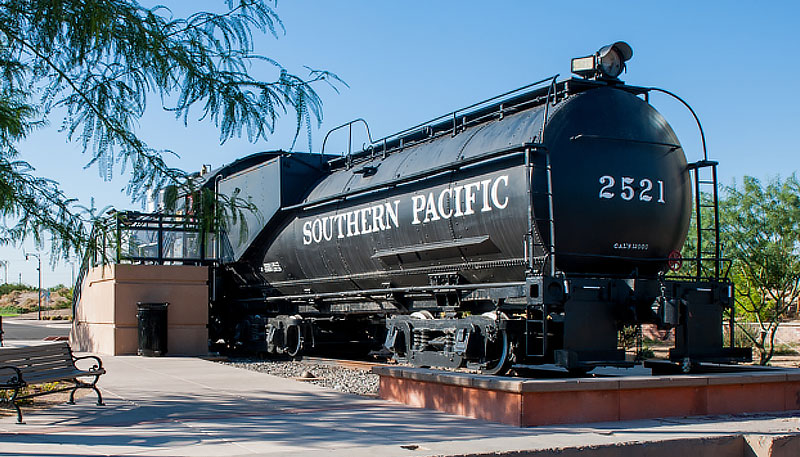
Where Madison Avenue meets the south bank of the Colorado River in downtown Yuma, a massive black 1907 Baldwin steam locomotive sits parked on original iron tracks overlooking the water. Just steps away rests a weathered circular slab of concrete that most passersby might mistake for an old foundation.
That concrete circle is one of the most consequential engineering relics in the American Southwest. Pivot Point Interpretive Plaza marks the spot where the first railroad train entered Arizona in 1877, crossing under cover of darkness to outmaneuver the federal government.
"Even before the 1,200-foot long wooden pony-truss bridge was completed, the first train crossed into Yuma under cover of darkness on September 30, 1877." — Historical account of Southern Pacific's arrival in Arizona
The midnight crossing
In the late 1870s, the Southern Pacific Railroad was racing east across California toward the Colorado River, locked in a fierce battle with rival rail lines for federal land grants. The bridge led directly onto the U.S. military reservation at Yuma, and officials in Washington had not yet granted permission for trains to cross.
Unwilling to wait on Washington politics, Southern Pacific crews laid track down Madison Avenue anyway. On September 30, 1877, Engine No. 31 rolled across the unfinished wooden bridge at night. By morning the train was parked in Yuma, and Arizona's railroad era had begun.
Why it is called Pivot Point
When Southern Pacific built that first crossing along Madison Avenue, steamboats like Captain Jack Mellon's Gila were still the lifeblood of Colorado River commerce. A low wooden bridge would have blocked the river and strangled riverboat traffic.
Engineers solved the problem with a swing-span bridge. Whenever a steamboat approached, workers cranked open a central section of the railroad bridge, rotating it like a giant gate atop a massive concrete pivot anchored in the river channel. Once the paddlewheeler passed, crews swung the tracks back into alignment so trains could roll on.
That original concrete pivot still survives where it was built, giving Pivot Point Plaza its name.
Floods, fire, and a forgotten riverfront
The Madison Avenue crossing sparked an immediate commercial boom and gave rise to the lavish Southern Pacific Hotel, famous in territorial days for hot and cold baths, a barbershop, and big-city luxury in the middle of the desert.
The Colorado River proved a relentless enemy. Floods washed out the first wooden bridge in 1884, fire destroyed its replacement less than a year later, and a third wooden span had to be built in 1886. After a series of devastating floods, Southern Pacific abandoned the Madison Avenue crossing in 1922 and moved its tracks to higher ground between the granite bluffs beside the Ocean-to-Ocean Highway Bridge, where Union Pacific trains still cross today.
Cut off from rail traffic, Madison Avenue fell quiet for decades. A $1.6 million revitalization project opened Pivot Point Interpretive Plaza in 2010 as a centerpiece of the Yuma Crossing National Heritage Area.
What you'll experience today
The plaza is a compact lesson in how the river, the railroad, and the city grew around one another. Look for the locomotive, the surviving pivot, and the views across the channel.
- Southern Pacific Locomotive No. 2521: Visitors can walk up to—and climb aboard—the restored 1907 Baldwin 2-8-0 steam locomotive, donated to the City of Yuma by Southern Pacific in 1957 and positioned on the original 1877 track alignment.
- 21st-century soundscapes: Hidden audio systems recreate the clanging bells of passing steamboats, the groan of the swing-span bridge cranking open, and the hiss of arriving trains at the old Southern Pacific Hotel.
- The full Yuma Crossing story: Interpretive panels connect the landmarks within eyesight, from the Yuma Territorial Prison and Fort Yuma to the Quechan Tribe, the Quartermaster Depot, and the 1912 Yuma Siphon that turned the desert into America's winter salad bowl.
Keep reading
Follow the next thread.
 History
Secrets Beneath the Sand
The complete story of Yuma, from the river crossing to the winter salad bowl.
Read the story History
Pearl Hart: The Bandit Queen of Yuma
Pearl Hart robbed a stagecoach, fooled a jury, and escaped Yuma Prison.
Read the story History
The Dark Cell
America's most haunted room. Cold spots, scorched handprints, and a whisper that says Stay.
Read the story