
Lakes & Water
Mittry Lake Wildlife Area
Mittry Lake looks natural, but it was made by two dams—and it covers a gold-rush town that vanished overnight.
A lake on top of a lost gold town
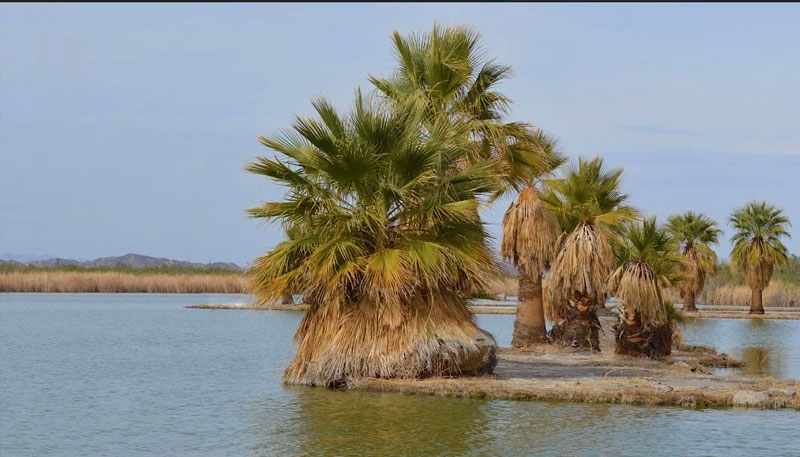
Fifteen miles northeast of Yuma, wedged into the narrow desert corridor between Imperial Dam and Laguna Dam, sits a sprawling, reed-lined backwater oasis where kayakers paddle through maze-like cattail channels and anglers cast for largemouth bass beneath jagged volcanic mountains.
Today the Mittry Lake Wildlife Area encompasses roughly 600 to 750 acres of open water and 2,400 acres of surrounding marshes and desert scrub.
This tranquil desert sanctuary is not a natural lake at all. It is an accidental man-made backwater born out of early 20th-century dam engineering—sitting directly on top of a vanished 1860s gold-rush town.
La Laguna's overnight disappearance
Long before federal engineers reshaped the river, prospectors poured into the canyons north of Yuma during the late-1850s gold rush.
By 1860, a bustling mining camp called La Laguna sprang up along the riverbanks right where Mittry Lake sits today.
Like so many frontier boomtowns, La Laguna burned bright and vanished fast. In 1862, news broke of a richer gold strike upstream at La Paz. Nearly the entire population packed their gear and abandoned the town overnight.
For the next four decades, early homesteaders—including pioneer railroad man Finley Barkley—farmed and ranched the quiet river bottomlands.
How two dams made an accidental oasis
The landscape changed forever in the early 1900s when the U.S. Reclamation Service built Laguna Dam, completed in 1909—the first dam constructed across the Colorado River.
Backing up water behind the dam flooded the old homesteads and submerged the forgotten ruins of La Laguna beneath a shallow, sprawling marsh.
Three decades later, the completion of Imperial Dam five miles upstream trapped the lake between two major water-control structures, stabilizing the backwater channels that form Mittry Lake today.
The area is named after early Yuma settler, river entrepreneur, and land developer Henry C. Mittry. The backwater evolved from an irrigation byproduct into one of southwestern Arizona's richest wetland habitats.
Keeping the backwater alive
Desert backwaters naturally fill with silt and dense reeds over time, so state and federal agencies stepped in to preserve the lake.
The area is jointly owned by the Bureau of Reclamation and the Bureau of Land Management, and managed in partnership with the Arizona Game and Fish Department.
Major dredging, channel clearing, and native cottonwood-and-willow restoration projects have kept open water flowing for both wildlife and boaters.
The result is a working wetland: shallow channels, marshy edges, and open water held between two dams.
A globally important bird area
Today Mittry Lake is recognized as a Global Important Bird Area, serving as a critical breeding sanctuary for the rare California black rail and Yuma Ridgway's rail.
Ospreys, snowy egrets, white pelicans, and migratory waterfowl also use the lake and its marshes.
Birders, kayakers, and anglers share the water with mule deer, javelina, bobcats, and desert bighorn sheep on the surrounding uplands.
The wildlife area is a paddle-and-wildlife destination rather than a resort lake. Check current access and fishing regulations before launching or casting.
Questions
Before you go
How was Mittry Lake formed?
It is an engineered backwater. Laguna Dam, completed in 1909, flooded the old river bottom, and Imperial Dam later stabilized the channels between the dams.
What happened to La Laguna?
The 1860s gold town was abandoned almost overnight after the 1862 La Paz strike. Its ruins were later submerged when Laguna Dam backed up the river.
What can you do at Mittry Lake?
The wildlife area is popular for kayaking, fishing, birding, and wildlife viewing. Check current access and Arizona fishing rules before you go.
Last reviewed: November 17, 2026. See our sources and editorial policy.