
Desert & Wildlife
Palm Canyon (Kofa)
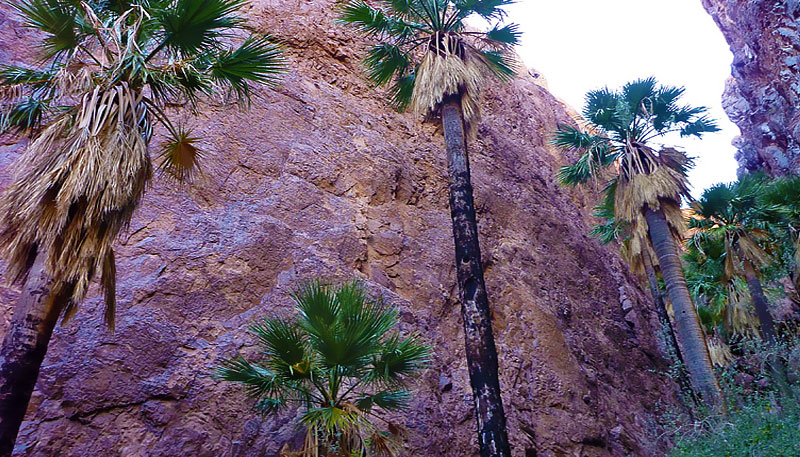
Arizona's native California fan palms grow high in a shaded Kofa canyon—a botanical relic reachable by a short, rocky trail.
A desert canyon with a secret
Drive north from Yuma on U.S. Highway 95, turn east onto a dusty desert track, and climb into the jagged volcanic spires of the Kofa Mountains. Wedge yourself inside a narrow, sheer-walled slot canyon hundreds of feet above the desert floor, and you will spot something that has no business surviving in one of the hottest, driest corners of North America: wild native palm trees.
Hidden inside Kofa National Wildlife Refuge, Palm Canyon is one of the only places in Arizona where native California fan palms (Washingtonia filifera) grow naturally in the wild.
The grove is a living botanical mystery tucked inside a 665,400-acre wilderness originally set aside to save Arizona's desert bighorn sheep.
The contrast is the point. Every palm lining a Yuma street or a Phoenix boulevard was planted by people. The palms wedged into this canyon were growing there long before modern roads or irrigation canals existed.
How did palms reach a dry Arizona range?
For more than a century—ever since botanist O.F. Cook documented the grove in 1923—scientists have debated how the palms got there.
One classic theory holds that they are living relics from the Pleistocene epoch, when southwestern Arizona was far cooler and wetter. As the climate dried over thousands of years, the palms retreated into this shaded, north-facing crevice where trapped winter rainwater and natural rock seeps kept their roots alive.
Other researchers suggest that birds, coyotes, or Indigenous travelers moving between the Colorado River and desert waterholes carried palm seeds into the canyon, where the sheltered microclimate allowed them to take root.
Whatever their origin, the canyon acts like a natural stone refrigerator. Its towering volcanic walls block the brutal afternoon sun, creating a cool, humid pocket where desert fan palms thrive beside saguaro cacti and ocotillos.
From King of Arizona gold to a bighorn refuge
The Kofa Mountains take their name from the historic King of Arizona, or K of A, Mine—a rich gold strike discovered in 1896 that operated deep in the range.
By the 1930s, unregulated hunting and habitat loss had pushed Arizona's native desert bighorn sheep to the brink of extinction.
In 1939, following a statewide conservation campaign sparked by the Arizona Boy Scouts, President Franklin D. Roosevelt established the Kofa Game Range. It was renamed Kofa National Wildlife Refuge in 1976.
Today the refuge protects a thriving herd of hundreds of desert bighorn sheep and serves as a core breeding population used to reintroduce bighorns across other southwestern mountain ranges.
Hiking the Palm Canyon Trail
Designated a National Recreation Trail in 2007, the Palm Canyon Trail packs big scenery into under a mile.
From the trailhead parking area, a rocky, moderately steep path climbs roughly 0.45 miles into the mouth of the canyon, gaining about 230 feet in elevation. The round trip is about 0.9 miles.
At the official viewpoint marker, look sharply up and to the left into the narrow side cleft to spot the green crowns and shaggy "skirts" of the native palms wedged high between the vertical cliffs.
Past the official viewpoint sign, the route becomes a steep, unmaintained boulder scramble. The best view of the palms is from the marked viewpoint, so bring binoculars and save your ankles.
Wildlife above the palms
Scan the craggy ridges above the trail. Visitors frequently spot desert bighorn sheep effortlessly navigating the vertical rock walls.
The canyon also draws canyon wrens, golden eagles, and white-throated swifts.
Go early or late for cooler temperatures and better light. The palms are shaded for much of the day and catch direct sun only for a short time around midday.
The refuge is a wilderness, not a city park: stay on the trail, carry water, and give wildlife room.
Questions
Before you go
Where is Palm Canyon?
It is in Kofa National Wildlife Refuge, north of Yuma via U.S. Highway 95 and Palm Canyon Road. The trailhead is at the end of the dirt road.
How hard is the Palm Canyon Trail?
It is about 0.9 miles round-trip with roughly 230 feet of elevation gain. The path is rocky and moderately steep, but the native palms are visible from the official viewpoint.
Are the palms really native?
Yes. The California fan palms in Palm Canyon are the only native palm species in Arizona and grow there naturally, not from planting.
Last reviewed: November 17, 2026. See our sources and editorial policy.