

Snowbirds
A City Within a City
The Economics of Yuma's Winter Invasion
Chapter I: The Numbers
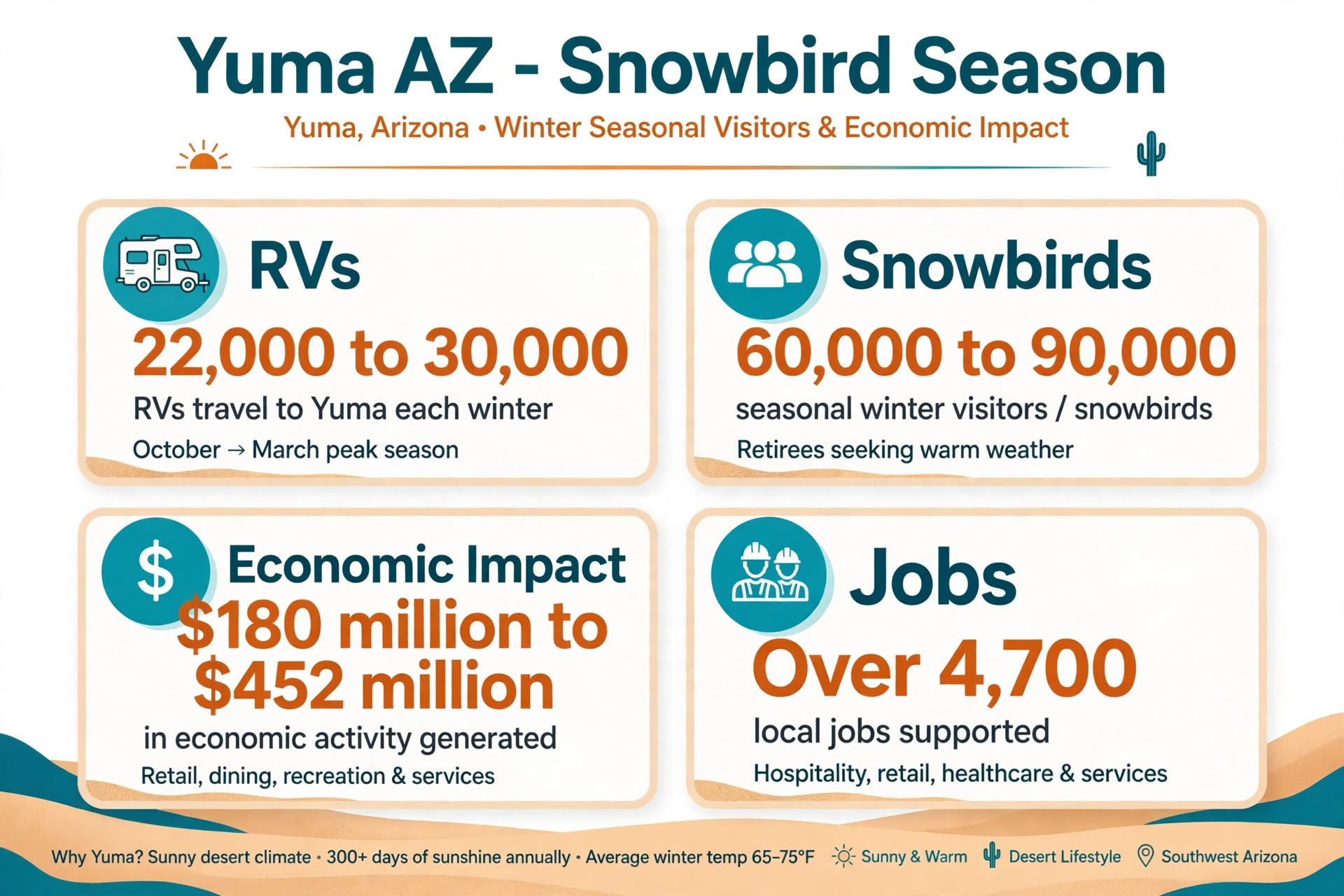
Between 60,000 and 90,000 winter visitors arrive in Yuma County each October and stay through April. That is a population roughly equivalent to the entire city of Flagstaff, Arizona.
9,154 households own seasonal homes or mobile lots in Yuma County. Yuma County hosts 44 RV parks with 15,486 leased lots.
Approximately one-third of all RV winter visitors come from Canada. 15% of all Yuma snowbirds are Canadian.
During a six-month window, Yuma County receives an estimated $179 million in direct spending from winter visitors. When indirect and induced economic effects are calculated, the total economic impact reaches $453 million — nearly half a billion dollars — for a single winter season.
Chapter II: The Money Trail
Seasonal homeowners — direct spending: $40.3 million.
RV park population direct spending: $138.7 million ($6,305 per travel party).
The economic impact multiplier transforms $179 million in direct spending into $453 million in total output.
State and local taxes: $40.6 million. Federal taxes: $34.9 million.
Total employment impact: 5,454 jobs.
Chapter III: The Jobs
The snowbird economy employs real people in real jobs.
RV park operations: 44 RV parks require managers, maintenance staff, activity coordinators, and security.
Hospitality and food service: Winter business doubles or triples. Chris Wheeler at Prison Hill Brewing Company says winter business doubles or triples.
Entertainment and events: The Medjool Date Festival attracts 5,500 attendees. The Lettuce Festival draws 4,000. Midnight at the Oasis — the largest event — attracts 40,000 people.
Chapter IV: The Culture
Snowbirds do not simply visit Yuma. They colonize it. They establish routines, form clubs, organize potlucks, poker nights, hiking groups, book clubs, and church services.
Thomas Wells, a snowbird from New York: "There's a lot of things happening in Yuma, the Date Festival, we go to the Tamale Festival."
Another visitor: "The only place I have to worry about snow or look at snow is in a distant mountain, and the only ice I have to deal with is in the drink I hold in my hand."
Chapter V: The Tensions
For all the economic benefits, the snowbird phenomenon is not without its shadows.
Traffic and congestion: Adding 90,000 people to a community of 210,000 is equivalent to increasing the population by 43% for six months.
Healthcare strain: Many snowbirds are elderly—the demographic most likely to require emergency care.
The 2024-2026 political tension: Canadian snowbird attendance dropped amid political controversy and tariff disputes.
The question lingers: what happens if Canadians stop coming?
Chapter VI: How It All Began
The seeds were planted in the 1950s and 1960s, when the post-war economic boom created America's first mass middle class.
Yuma's snowbird story is inseparable from the RV revolution. Yuma remained affordable while Phoenix and Tucson prices rose. Yuma became the working-class snowbird destination—the place where teachers, factory workers, and small-business owners could afford to spend their golden years in the sun.
Chapter VII: The Future
Climate change is the most existential threat. Remote work is changing the equation. The baby boomer generation is aging.
And yet, for all these risks, the snowbird phenomenon shows no signs of collapse. In January 2024, Visit Yuma reported a 5% increase in visitors.
Thomas Wells: "There's maybe prettier places in Tucson, maybe in Phoenix, but the people here in Yuma are amazing."
That, in the end, may be Yuma's true competitive advantage. Not the sunshine—Florida has that. Not the affordability—Mexico has that. Yuma's secret weapon is its people.
Keep reading
Follow the next thread.
 Snowbirds
The RV Wash Capital of the World
Why Yuma became the RV wash capital of the world.
Read the story History
Secrets Beneath the Sand
The complete story of Yuma, from the river crossing to the winter salad bowl.
Read the story History
Pearl Hart: The Bandit Queen of Yuma
Pearl Hart robbed a stagecoach, fooled a jury, and escaped Yuma Prison.
Read the story