
Technology
Yuma's AI Testing Ground
Robot weeders, a tribal data center, and the fight over the desert's next industry
The field is the laboratory
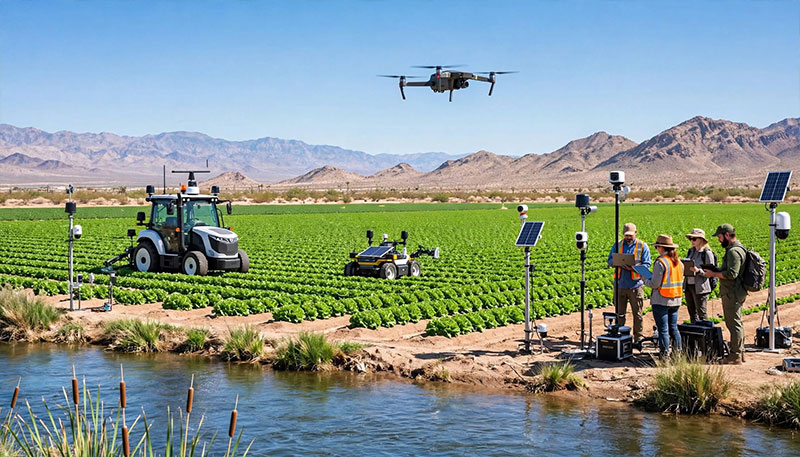
Yuma grows an estimated 90% of the nation's winter leafy greens. That makes the county a natural place to test machines that have to work in heat, dust, and a compressed harvest window.
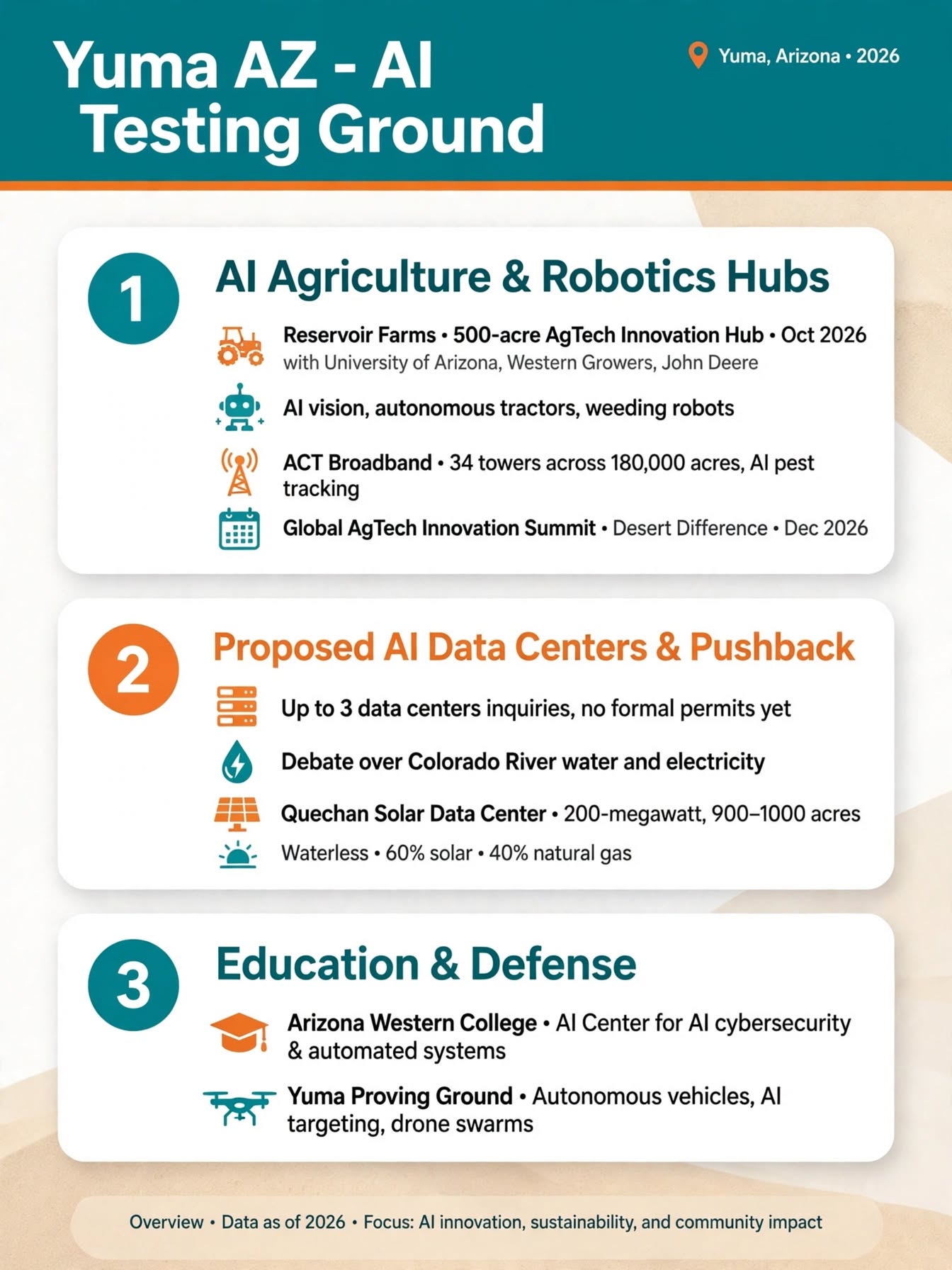
In October 2026, Reservoir Farms opened a 500-acre pilot at the University of Arizona Yuma Agricultural Center. It is the company's first location outside California. The partners include the Yuma Center of Excellence for Desert Agriculture, the Yuma Agricultural Center, Western Growers, and John Deere.
Startups at the site can test AI vision systems, autonomous tractors, and weeding robots against commercial winter crops. The point is not a demo day. It is to find out which machines survive a real field and save a grower money.
The network under the fields
The other half of the ag-tech story is connectivity. A county-led project is building 34 wireless broadband towers across roughly 180,000 acres of farmland, with a test tower at the Yuma Agricultural Center.
The network is designed to connect sensors, drones, and equipment. Researchers say it can support real-time crop monitoring, pest tracking, and remote irrigation — the data layer that makes AI useful in a field.
Officials describe it as the largest agriculture-only wireless network in the world. Whether that superlative holds, the practical test is simpler: can a grower in a remote field get the same data as one beside the office?
The summit
Yuma will make its pitch in person at The Desert Difference: Global AgTech Innovation Summit, scheduled for Dec. 9–10 at the University of Arizona Yuma Agricultural Center SMART Farm.
The event is built around live field demonstrations: automation, AI, robotics, sensors, and water-saving tools working together on commercial fields. Organizers call the centerpiece an Integrated Testbed.
For Yuma, the summit is less a conference than a sales pitch to the rest of the farming world: if a technology can survive here, it can survive anywhere.
The data-center question
The attention is not only in the fields. Yuma is also in the middle of a fight over data centers — the power-hungry buildings behind AI.
In April 2026, the Greater Yuma Economic Development Corporation hosted an informational session that drew protesters. In June, GYEDC said it had received numerous inquiries from developers, brokers, and consultants, but that no project had made a financial commitment or submitted a permit application. Reporting at the time described up to three developers eyeing desert land.
The picture changed in November. Yuma Informed reported that a 10-acre parcel south of Yuma was scheduled for a Yuma County Planning and Zoning hearing on Nov. 24. The requests: a rezoning and a special use permit for a "communications and data processing facility." The legal notice did not use the words "data center."
City officials have said no application has been filed with the city. That distinction matters. The first formal request is moving through the county, not the city.
The concerns are water and power. Yuma relies on the Colorado River for nearly all of its supply, and data centers can be intensive users of both. Supporters point to jobs, construction, and new tax revenue. Opponents ask what happens to the river and to electric bills.
The tribal proposal
Across the river, the Fort Yuma Quechan Indian Tribe is considering a different model.
In spring 2026, the tribe announced due diligence on the Quechan Solar Data Center Project: a 200-megawatt solar microgrid and AI data center on 900 to 1,000 acres of reservation land. The design would be modular and mechanically cooled, with no water used in the cooling process. The tribe says 60% of the power would come from solar and 40% from natural gas.
The project would lease tribal land and would not use tribal funds for development, according to the tribe's proposal. It has also drawn opposition from tribal members concerned about land, water, and air impacts.
For Yuma, the proposal is a reminder that the AI buildout is not only a city issue. It crosses the river, the reservation boundary, and the state line.
The workforce and the range
The AI economy also needs workers and a testing range.
Arizona Western College launched its Regional Center for Emerging Technology in 2026, with AI and machine-learning certificates, a degree, a learning lab, and community workshops. The college also teaches cybersecurity, a practical complement to AI work.
At Yuma Proving Ground, the Army has tested AI-enabled targeting, autonomous systems, and counter-drone technology. In 2026, the Falcon Peak 26.2 exercise brought 21 companies to the range to evaluate counter-UAS systems. Not all of that work is public.
Yuma is not a hyperscale AI campus town. It is something more specific: a desert test lab where agriculture, defense, and data infrastructure meet.
What to watch
Three dates and decisions will shape the next chapter.
- Nov. 24, 2026: The Yuma County Planning and Zoning Commission is scheduled to hear the 10-acre communications and data-processing request.
- Dec. 9–10, 2026: The Desert Difference summit brings the ag-tech industry to Yuma.
- The 2026–27 winter season: Reservoir Farms' first Yuma trials run through March. The results will show whether the machines deliver in commercial fields.
The larger question is not whether AI comes to Yuma. It is already here in field trials, classrooms, and military testing. The question is what kind of deal the county makes with the infrastructure that powers it — and who gets to decide.
Sources and status
This story draws on reporting and public documents from KAWC, Arizona's Family, Yuma Informed, the U.S. Army, Arizona Western College, Reservoir Farms, the Quechan Tribe, and the Desert Difference summit. Project details can change; confirm current status with the responsible organization. This is an independent guide, not an endorsement of any project.
Keep reading
Follow the next thread.
 Snowbirds
A City Within a City
The $453 million economy of 90,000 winter visitors.
Read the story History
Secrets Beneath the Sand
The complete story of Yuma, from the river crossing to the winter salad bowl.
Read the story History
Pearl Hart: The Bandit Queen of Yuma
Pearl Hart robbed a stagecoach, fooled a jury, and escaped Yuma Prison.
Read the story